
So, your mom read your erotic gay romance. How’d that work out?

yourmomWhile Starling and Doves are under lock and key as we go into the editorial process with our publisher, there was one person beyond the first readers that helped us through our initial process who we’ve let read the books.

It’s Erin’s mom.

And she’s really into them and can’t wait for the next installment. Although she tells us she skips over the sex.

Which didn’t stop me from getting this hilarious email from Erin five minutes ago because her mom has just finished Doves:

I just talked to my mom.

Who was like “YOU NEVER ANSWERED MY QUESTION WHAT DID VICTOR DO TO THEM?”

I was like “Oh, that was a specific question? I thought that was like just, rhetorical, oh my god.”

“NO. NO WHAT DID HE DO?”

So now I get to write an email explaining, among other things, subspace to my mother!

Neither Starling nor Doves are BDSM novels, and BDSM isn’t a particularly overt part of any of the characters lives. But circumstances, often non-sexual ones, do crop up that are very much informed by power exchange. These circumstances tend to center around Victor, the creator and showrunner of a popular TV political thriller, who is for some of our characters very much a villain and for others, anything but.

I’m writing this blog post because Erin has to go face her mom. And also because I can’t stop laughing.

P.S. — Victor’s Twitter handle is @TheShowYouHate. Maybe you want to start following it now, so you don’t miss anything when we start letting him out to play.

Posted in Doves, Love in Los Angeles, Starling, Writing | Tagged , , , , , , | Leave a comment

What’s the time difference between D.C. and Pretoria?

planeThe things cowriting makes you Google, or at least glance at a map for. (The answer, by the way, is six hours, which tends to be a really good spread for us.)

Racheline’s going to South Africa in May for her day job, which means we’re digging out our calendars and adjusting our project schedule to take best advantage of the time zone factor.

One of the biggest challenge of cowriting is juggling not one busy schedule (family, day job, chores,  commute, that annoying need for sleep) but two. Our particular cowriting team has the added factor that Racheline travels for her day job, often way outside Eastern Standard Time.

What looks like an obstacle, though (“Oh god are we even going to be awake at the same time?”) is usually a huge boon. In fact, our ability to work the timezones is a big part of how we’ve been able to write as much as we have as quickly as we have. When we’re on mismatched work and sleep cycles, there’s always someone awake and writing and our stuff moves forward pretty much 24 hours a day.

(The really tricky part is avoiding the temptation to get up at two in the morning to check my email, when I know notes will be coming through from a different continent.)

The key to making the timezones work — and it’s the same key that makes cowriting, in general, work — is planning and communication. Racheline and I keep a master spreadsheet with all of our projects, sorted by medium — novels vs. short stories vs. scripts/screenplays — and organized by due dates. When we have a time zone split coming up, we look at our spreadsheet and triage by due date and what benefits most from a big chunk of concentrated time. We come up with a plan, we write it down, and we keep our fingers crossed against disaster. (Another key to making writing work, in general, is being okay with the fact that nothing goes according to plan. Ever. But be flexible, adjust accordingly, and everything will be fine!)

As a process/tehcnology note, Racheline and I do all of our writing together in Google Docs, and all of our planning, brainstorming, and freaking out in email. We have a shared office in Philadelphia we visit together a couple of times a month, and while that’s a massive asset in terms of being able to work through a lot of edits and brainstorming quickly (can anyone say MASSIVE WHITEBOARD?) we wouldn’t be able to do a fraction of what we do without those collaborative tools.

And the magic of the Internet is, of course, that it works pretty much everywhere we’ve had occassion to be. In the nine months we’ve been writing together, we’ve put words on the page while one or the other of us have been in 13 different cities: New York City; Washington, DC; Philadelphia; Zurich; Milan; Los Angeles; San Francisco; Seattle; Rochester NY; Columbus, OH; London; Berlin; and Rome.

An added bonus of all that travel is that, as we’ve started working on more projects set in different locations, travel gets to double as research trips (I.e., Racheline and my respective trips to Los Angeles and New York City!)

And on that note: Does anyone know of anyplace cool Racheline can go when she’s in Pretoria? 🙂

Posted in Cowriting, Travel, Writing | Tagged , , , , | Leave a comment

So, you’ve written an erotic gay romance. What does your mom think?

yourmomWhen my mother found out that we’d signed a contract on Starling (now the first book in the Love in Los Angeles series) she was proud.  Then, when she found out it was a romance novel, she asked me if I was.

It’s a sticky thing, the inevitable discussion of genre and status, that is further complicated by Starling being an LGBT romance, containing a good deal of sex, and, btw, being about the television industry, which is where we tend to dump our low-art pop-culture anxieties.

So I talked to my mom about the genre’s popularity and about how it gets marginalized because it’s most often read and written by women.  I told her the stuff that made her ask me this question echoes the way we treat “prestige” television vs. episodic network television. One is associated with a male-dominated film culture, while the other ties back more closely to daytime soaps.  We can talk about content and production values all day long, but the reality is that our reaction to the idea of the romance genre often comes from a deeply gendered and biased place that we regularly apply to all sorts of media.

Mostly though, I sort of felt like a jerk for addressing the question at all. And not just because my mom just wanted to make sure I was happy. I also feel like a jerk when I wind up defending why Erin and I write LGBT romance and why we tend to refer to it that way when m/m romance seems to be the marketing category label of choice.  To me, these always feel like questions that shouldn’t quite be on the table.  After all, why tell any story?  Why not ask us why we chose this one, versus this genre or type?

My mom, meanwhile, hasn’t decided if she’s going to read Starling yet.  I told her she could, and considering she survived (and loved) the musical about dominatrixes I wrote the book for, she might love Starling and its sequels too.

But in the meantime, I’ve got to figure out a soundbite for all these What’s up with that? questions.  Because saying that the relationships in Starling include characters of various genders who are gay, straight, bisexual, and asexual; polyamorous and monogamous; and that all those characters define those terms slightly differently than every other character, is a little exhausting.  And yes, when we say LGBT, we do mean all four of those letters and more, although not all of them appear in the first book.

But basically, labels are weird.  Starling’s hero Alex gets the job that changes his life because of a label he hates. Ultimately, he figures out about himself what I think I’ve figured out about these books: sometimes labels are just for other people’s benefit, and it doesn’t always hurt to run with them.

Which basically means the next time my mom asks me if I’m proud, I’m just gonna shrug and say of course.  It’s not about me anyway.  It’s about the story.

Posted in Doves, Love in Los Angeles, Starling, Writing | Tagged , , , , , , | Leave a comment

Rochester, NY

Lake Ontario, December 2013Even though we began Starling way earlier, the first story of Racheline and mine to be released is a short story in a wedding-themed anthology from Torquere Press. Unlike Starling, “Lake Effect” isn’t set in New York or L.A. or any of the other world class cities we explore in that book and in the Love in Los Angeles series. It’s set in Rochester, New York.

Racheline and I both have a lot of personal history with Rochester, at very different times. She’ll tell her story at some point, but this one is mine.

I was born in Rochester and I grew up in Rochester. I met the guy I would end up marrying, and married him, in Rochester. Our families are still there, and Christmas still means a trip to Rochester.

(And while we’re at it, you’re probably saying it wrong. RAH-chister. Not RAW-CHES-ter. Make those As broad.)

Rochester used to be a great city, and a lot of history happened there. It was a terminus for the Underground Railroad. Frederick Douglass and Susan B. Anthony called it home. When I first fell in love with stories, it was with history books, many of them about the region I grew up in and the people who lived there.

Rochester is smack in the middle of some beautiful geography: The Genesee River valley, the Fingerlakes are gorgeous, not to mention Lake Ontario.

Rochester is also dying.

For decades it was a company town. Everybody worked at Kodak, until Kodak didn’t transition fast enough to digital and the film industry crumbled. What had been a thriving industrial park is now shuttered brick buildings and parking lots growing weeds.

The summer after my first year of college, I worked at a Kodak factory. I spent days crammed into the machines, cleaning grease off with an incredibly unpleasant mix of water and ammonia. It sucked. It was hot, it was cramped, it was boring, it was sometimes hard to breathe. I went home every day feeling like I was absorbing the grease and the chemicals through my skin. I probably was.

The machines I was crammed into were the machines that made movie film. Find any movie made before 2005, watch to the end of the credits, you’ll probably see a “Kodak Film” logo right at the end. Yup, my factory, my machines, made right there. If it had been in the days of camera phones, I’m sure there would be a picture of me sitting on the machine, in a filthy Tyvek suit, holding a bucket of ammonia and a handful of rags.

It sucked, but I got to say I helped make movies, because I did. It sucked, but I got a good story out of it!

That’s what Rochester taught me. Maybe that’s a dubious honor, that Rochester is such a shitty place that the most important thing I learned there was to get the fuck out and in the meantime, tell myself stories about how my life was interesting even when it was miserable.

Besides, it’s Rochester. The history of that city is long and winding and not over yet. Growing up with an awareness of that history, and the importance of all history I also grew up knowing that my own story was a part of that history. My life was a part of the city’s, and whatever city I left it for to call my home after that.

Sometimes, stories are all you have. Your story, and the knowledge that it fits somewhere in the world, that it matters. No one else is going to tell your story for you. So you have to tell it. It’s what I did, one miserable summer sweltering in a factory that’s been bulldozed since, because no one makes movies on film anymore.

This is where we got “Lake Effect” from. The Rochester in that story isn’t my Rochester, not exactly, although I spent a lot of time in the “Lake Effect” Rochester and know it very well. My own relationship with the place is more nuanced and more complicated, though not necessarily happier. It’s a rich and complex and complicated place, and it’s story isn’t quite over yet. And as I keep telling stories about it, and as Christmas keeps being there, my relationship with it isn’t over yet either.


Posted in Lake Effect, Travel, Writing | Tagged , , , , , , | 1 Comment

New York Minute

I grew up in New York State, in Upstate New York, in Rochester, New IMG_20140217_121408York, but never in New York because when you say “I’m from New York,” to someone from out of state, the assumption is, always, that you’re from New York City. And although I’ve lived my entire adult life in major cities — first Toronto, now Washington, DC — cities, and NYC in particular, are not my thing.

New York City is particularly well-tailored to be bad for me; it is very big, very crowded, and very fast-paced. The first time I went there — which wasn’t until I was 18, even though I had grown up less than a day’s drive away — I hated it. I grew up in a suburban area that edged on rural, and I love space and silence and a lack of people. New York City has none of these things.

NIMG_20140216_135138YC is hard for our characters, too. Sometimes the city itself is a friend, sometimes it’s an enemy; sometimes it’s background noise while the dramas of human existence play out; sometimes it’s a refuge from that drama. It is never, however, easy.



But New York is a deeply romantic city, and as I started to take trips there as an adult, I began to discover that romance. New York is still too tall and often too crowded, but I’ve stopped hating it for not being something other than it is — a massive and complex organism, a character in the story of the life of anyone who passes through it, or dreams of it, or runs from it — and fallen in love with it.IMG_20140216_000414

This past February I went to New York City for a weekend with my husband, and, both with him and alone, I walked all over Manhattan with a list of locations from our books and my camera. I’ve been to New York City a handful of times before by now, and Racheline lives there and had described many of the places to me already, but I still wanted to research I wanted to travel to the actual places we write in our books.

I don’t particularly believe in ghosts, but I have had moments, standing on battlefields or in old buildings or the site of some great event, where I have definitely felt something. The energy of moments lingers, perhaps; maybe it’s my imagination combining with my factual knowledge. Whatever it is, it’s a deeply emotional experience, and New York City is rich in history and in energy and in my own connection to it via story. More than once I had to stop on a sidewalk to catch my breath because I had just walked past a place where some event in our book happens.IMG_20140216_203808

New York City is still not easy for me, and I will, for the rest of my life, identify myself as from New York State (“No not the city”). But I could fall in love with it, for the things in my imagination that happened there, and through that I can keep loving NYC for all that it is, in life and in our stories.


Posted in Doves, Love in Los Angeles, Starling, Travel, Writing | Tagged , , , , , | 1 Comment

California Dreaming

Like most native New Yorkers, I have a pretty conflicted relationship with Los Angeles. Much oLA2f that is merely logistical, after all, I don’t even know how to drive. But much of that is rooted in cultural differences around status, communication, and propriety. Generally, however, New Yorkers will often just say they don’t like Los Angeles because it doesn’t have seasons. After this past winter, that it seems we’re still digging our way out of, that argument seemed particularly invalid.

LA1Back in February, I was in Los Angeles. It’s a yearly trip, one I make to see friends and attend a Doctor Who convention, since it’s one of the properties I do a lot of my pop-culture writing on. This year, however, I had another mission, which was to do research for Erin and I’s books. After all, she’s never been to Los Angeles. So even the places I knew well, had to be documented for her.

Most of those pictures I’m not going to share now. They’ll make more sense once Starling and the later books in the series are out. But I did want to talk a little bit about what it means to fall in love with a city through the eyes of people who don’t even exist.

Writing is weird. No matter how you describe it — when you get to the part about what happens wLA3hen you’re in the groove, when the story wakes you up in the middle of the night with the solution to a structural problem that’s been haunting you for months, and when the characters become so alive they don’t just tell you their secrets but sometimes hide them from you — you sound pretty weird.
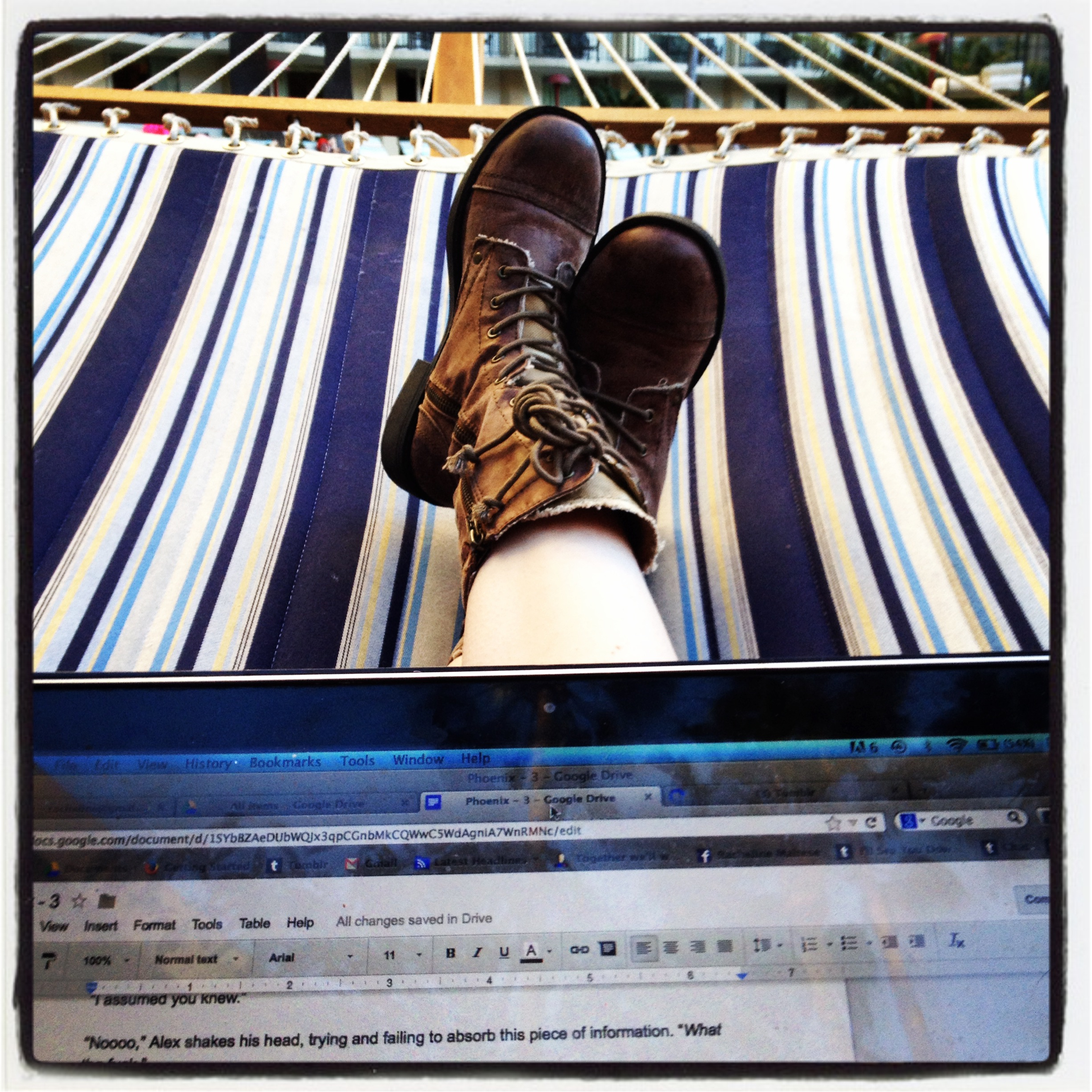
With a co-author, it’s doesn’t get less weird. How did we both know the cat was white? And why wouldn’t Alex (one of our Starling protagonists) tell us what happened to him in Indiana for months? That sort of psychic-fax, though, doesn’t tend to extend to the indisputably real, and so I spent several days dragging friends around Los Angeles because I needed photos of everything from our once-a-year brunch spot to a cathedral.

Writing_in_LAOver the last year, more and more of my focus has shifted towards Los Angeles. My pop-culture work, and my increased interest in and pursuit of telling screen-based stories have been significant drivers. So has the polar vortex. But at the end of the day, it’s taken a fictional story about fictional people to make a place that instills a deep insecurity in me as a New Yorker (am I pretty enough, charming enough for the mythology of Los Angeles?) the sort of place that makes me tear up when I get on the plane to leave.

Which means not only will you be seeing a lot more of Los Angeles from Erin and I’s keyboards, but that with any luck Los Angeles will be seeing a lot more of me.

Posted in Doves, Love in Los Angeles, Starling, Travel, Writing | Tagged , , , , , | 1 Comment